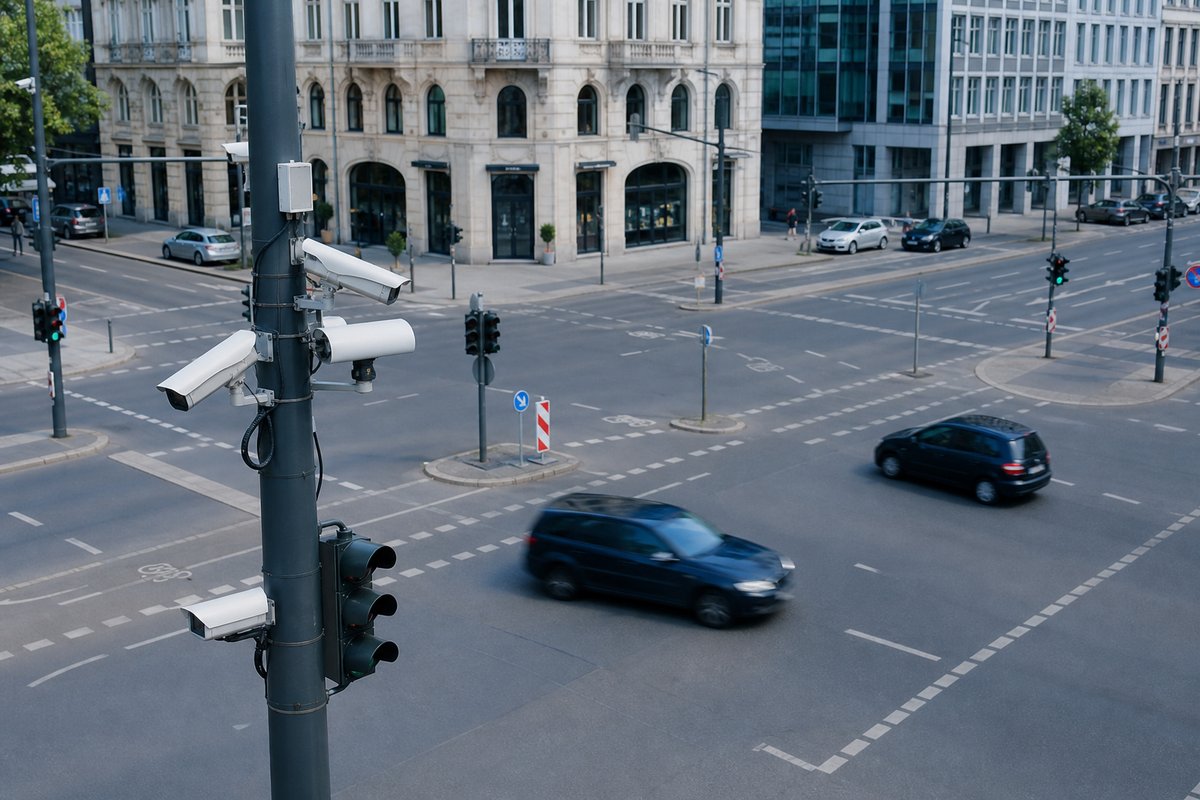
Road networks in European cities carry tens of millions of vehicle journeys every day. Managing that volume — keeping traffic moving, responding to accidents, and reducing emissions — requires systems capable of making thousands of decisions per minute. Smart traffic systems, also called Intelligent Transport Systems (ITS), are the hardware and software infrastructure that makes this possible.
What Are Smart Traffic Systems?
At their core, smart traffic systems combine data collection, data processing, and actuation. Sensors embedded in or above the road surface count vehicles and measure their speed. Cameras capture queue lengths and detect incidents. Processing platforms aggregate these inputs and translate them into commands that adjust signal timings, activate variable message signs, or alter speed limits on motorway gantries.
The distinction between a traditional fixed-time signal plan and a smart system is the ability to react to conditions as they unfold, rather than following a schedule written weeks in advance. A fixed-time plan can cope with predictable daily patterns; a smart system can handle the unexpected — the broken-down lorry, the unexpected event, the sudden downpour.
Core Detection Technologies
Inductive Loop Detectors
Inductive loops are wire coils cut into the road surface that detect the metal mass of passing vehicles. They are reliable and provide accurate counts and speed data, but require road closure for installation and maintenance. Most European cities retain large networks of loops installed during the 1980s and 1990s alongside more recent sensor types.
Video and ANPR Cameras
Modern traffic cameras perform two roles: incident detection (spotting stopped vehicles, wrong-way drivers, or debris) and journey-time measurement via ANPR (Automatic Number Plate Recognition). ANPR matches anonymised plate reads at different points on a route to calculate average speeds. London's surface network, Stockholm's congestion charge boundary, and Vienna's city-centre access scheme all rely heavily on ANPR infrastructure.
Radar and Microwave Sensors
Microwave radar detectors offer lane-by-lane occupancy, speed, and vehicle classification data without requiring road works. They are increasingly used to supplement or replace inductive loops on high-traffic arterials where lane closures carry high costs.
Adaptive Signal Control Systems
The two most widely deployed adaptive signal algorithms in Europe are SCOOT (Split Cycle Offset Optimisation Technique) and SCATS (Sydney Coordinated Adaptive Traffic System). Both work by continuously measuring queue lengths and arrival rates at signalised junctions and adjusting the split, cycle length, and offset of adjacent signals to form coordinated green waves.
| System | Update interval | Primary origin | Notable deployments |
|---|---|---|---|
| SCOOT | Every signal cycle (~90 s) | UK (TRL) | London, Birmingham, Lyon, Stockholm |
| SCATS | Every cycle | Australia (NSW) | Dublin, Hong Kong, Singapore |
| UTOPIA/SPOT | Real-time | Italy (Mizar) | Turin, Milan, Rome |
| MOTION | Real-time | Germany (Siemens) | Munich, Frankfurt, Nuremberg |
Complex Event Processing in Traffic Management
As sensor density has increased, so has the volume of data that traffic management centres must process. A single urban corridor can generate thousands of data events per minute from loops, cameras, floating vehicle data from GPS probes, and environmental sensors. Complex event processing (CEP) engines are designed to detect meaningful patterns within this stream in real time.
In a traffic context, CEP might identify that three consecutive junctions in a corridor are showing queue spillback simultaneously — a pattern that triggers an automated response, such as lengthening the green phase for the main flow or activating a diversion route on variable message signs. The response time from event detection to actuator command can be under five seconds on modern platforms.
European research programmes have invested significantly in CEP for traffic since the mid-2000s. Platforms such as Esper (open source) and commercial systems from Siemens, Kapsch, and Swarco implement CEP logic within their traffic management suites.
Notable European ITS Deployments
Vienna (VERA): Vienna's traffic management platform coordinates over 1,000 signalised intersections across the city and integrates tram priority, pedestrian demand, and air-quality sensors. The system feeds data into the city's public journey planner in real time.
Stockholm Congestion Charge: Stockholm has operated a cordon-based congestion pricing scheme since 2006 (made permanent in 2007). ANPR cameras record entries and exits; charges vary by time of day. Traffic volumes within the cordon fell by approximately 20–22% following introduction and have remained at lower levels.
Amsterdam Traffic Management Centre: The Amsterdam TMC handles over 300 million vehicle kilometres of traffic on the national motorway network surrounding the city each year, integrating data from the Netherlands Databank for Public Roads (NDW) with local city signals.
Challenges and Limitations
Despite their capabilities, smart traffic systems face recurring challenges. Data quality depends on sensor maintenance — a failed loop detector can distort an entire corridor's signal plan. Cybersecurity has become a growing concern as systems are connected over IP networks. Privacy regulations (GDPR) constrain how long raw ANPR data can be retained and who can access it. And the high upfront costs of hardware and integration mean that many smaller European municipalities operate mixed networks combining decades-old fixed-time plans with newer adaptive sections.
Frequently Asked Questions
What is a smart traffic system?
A smart traffic system is a network of sensors, cameras, and computing infrastructure that monitors vehicle flow and adjusts traffic signals dynamically to minimise congestion. Modern systems can also detect incidents, predict bottlenecks, and share data with navigation apps in real time.
How do adaptive traffic signals work?
Adaptive traffic signals use real-time data from inductive loops, radar, or video cameras to measure queue lengths and flow at each approach to an intersection. Algorithms such as SCOOT and SCATS adjust signal timings every cycle to reduce overall delay across a corridor or network. Offsets between adjacent junctions are also optimised to create coordinated green waves for the dominant traffic direction.
What is complex event processing in traffic management?
Complex event processing (CEP) is a computing approach that detects patterns across multiple data streams in real time. In traffic management, CEP engines analyse feeds from sensors, cameras, and GPS probes simultaneously to identify developing incidents, predict queue propagation, and trigger automated responses — such as variable speed limits or ramp metering — within seconds.
Which European cities have deployed intelligent traffic systems?
Vienna operates one of Europe's most comprehensive ITS platforms, the VERA system, coordinating over 1,000 signalised intersections. Amsterdam's traffic management centre handles over 300 million vehicle kilometres per year. Stockholm's congestion pricing system uses ANPR cameras to charge vehicles entering the inner city during peak hours, having reduced traffic volumes by roughly 20% since its permanent introduction in 2007.
What is ANPR in traffic technology?
ANPR (Automatic Number Plate Recognition) is a camera-based technology that reads vehicle registration plates, enabling authorities to identify vehicles, enforce access restrictions, calculate journey times, and operate congestion or clean-air zone charging schemes. ANPR is a core component of London's ULEZ, Stockholm's congestion charge, and many European border control systems.
How much can smart traffic systems reduce travel times?
Independent studies of adaptive signal control deployments have typically found reductions in average vehicle delay of 12–20% in urban networks. Corridor-level optimisation in cities like Birmingham and Lyon has achieved reductions of up to 25% during peak hours, though results depend heavily on network topology and baseline signal plan quality.
Published: